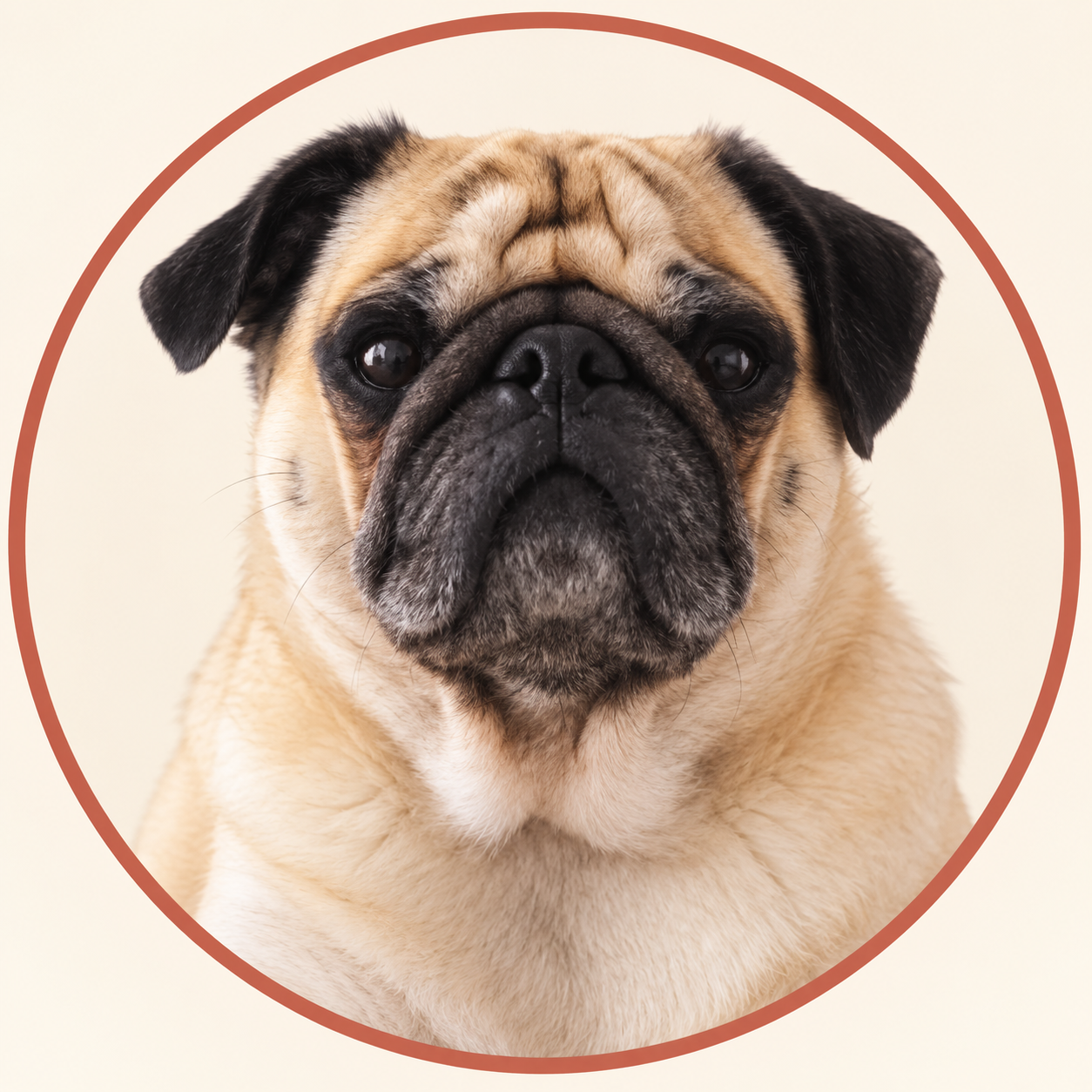
Healthy Pug Weight: Feeding, Treats, and the Begging-Face Problem
A pug can look thoroughly pleased with life while carrying more weight than is comfortable. The useful question is not whether your dog matches a breed-average number. It is whether the body condition, muscle, food intake, and activity suit this particular dog.
Start here: Ask your veterinarian to assess body condition and help set a daily feeding plan. Then measure the food, count the extras, and make the plan easy for everyone in the household to follow.
Use body condition as well as the scale
The WSAVA nine-point chart describes an ideal dog as having ribs you can feel without excess fat, a visible waist behind the ribs from above, and an abdominal tuck from the side. Scores around 4–5 out of 9 represent ideal condition on that chart. Ask your veterinary team to demonstrate the check on your pug; a thick coat and individual build can make a glance misleading.
Weight and muscle condition belong in the same discussion. Two pugs of different frames may have different healthy weights. A photograph, breed description, or online calculator cannot establish your individual dog’s target.
Make a three-day food record before changing everything
Choose ordinary days and record what actually goes into the dog, including the things that do not go in the bowl.
- Exact food name and amount at each meal.
- Training rewards: product, size of piece, and number.
- Dental chews and other edible chews.
- Food placed in lick mats, puzzles, or stuffed toys.
- Table bites, leftovers, and medication treats.
- Who gave each item. A shared note helps catch duplicate meals.
Bring labels or clear photos of them. “One scoop” does not tell your vet the scoop size, the food’s energy content, or whether somebody rounded it upward.
Turn an agreed calorie plan into a measurable portion
A kitchen scale makes small portions easier to reproduce. Put the empty bowl on it, set the display to zero, and weigh the food in grams. Check whether the plan describes the whole day or one meal.
If the label gives energy as kilocalories per kilogram, divide that number by 1,000 to get kilocalories per gram. Then divide the calories allocated to that food by its calories per gram.
Worked example — arithmetic only, not a calorie recommendation: Suppose a veterinarian has chosen 400 kilocalories for a particular dog’s day, including extras, and allocates 360 to the main food. A food labeled 3,500 kilocalories per kilogram provides 3.5 per gram. The daily portion of that food would be 360 ÷ 3.5, or about 103 grams, divided across the planned meals. Your pug’s actual target may be very different.
For canned food, mixed diets, or several foods with different energy densities, ask your veterinary team to write the quantities separately. Do not assume one gram or one cup of every food supplies the same energy.
Give rewards a place in the plan
AAHA advises that treats make up no more than 10% of daily calories. That is a ceiling, not an amount you must feed. Medical diets and individual plans may require different restrictions.
Put the agreed reward portion in one container each morning. Anyone who trains or gives a snack uses that container. Part of the normal meal can also become training currency instead of adding a second food allowance.
A dental chew or lick mat still counts when its purpose is useful. Check the product’s calorie information and serving instructions rather than judging by how small it looks.
Handle the begging face without changing the meal
Agree on the routine before dinner. Feed the planned portion, clear the food away, and offer an appropriate alternative such as a comfortable resting place or a brief game. A household rule is easier to keep than debating each expression individually.
If appetite changes suddenly or seems unusually intense, mention that to your vet. Do not assume every food-related change is a personality trait.
Add comfortable movement, not punishment laps
Choose activity your pug can enjoy without struggling: suitable sniffing walks, gentle play on secure footing, and easy search games. Keep heat, breathing tolerance, pain, and veterinary guidance in the plan. A shorter comfortable outing is more useful than pushing through distress to “burn off” a snack.
Try low-impact indoor activities when the weather is unsuitable. Stop and seek veterinary advice for concerning breathing, weakness, pain, or a marked change in stamina.
Check progress with your veterinary team
AAHA recommends an individualized approach that considers nutrition, activity, and behavior. Rapid or improvised weight loss can be unsafe. Ask for the planned rate of change, a weigh-in schedule, and when the food amounts should be reviewed.
- Use the same scale and similar conditions when possible.
- Keep the date and weight beside the food record.
- Note changes in comfort, appetite, stool, or willingness to move.
- Take consistent side and overhead photos if your vet finds them useful.
- If progress stalls, review the actual intake together before cutting again.
Do not put a growing puppy on an adult weight-loss plan. Discuss growth, health conditions, medication, unexplained weight change, and any diet restrictions with your veterinarian.
Common questions
Should I feed the amount on the bag? Treat the label as information to discuss, not a personalized prescription. Your vet can translate the chosen plan into a practical daily amount.
Do slow feeders reduce calories? They change how food is presented, not how much energy you put in them. Read the flat-face feeder guide for access and cleaning considerations.
Can everyone in the family give treats? Yes, if those rewards fit the dog’s agreed plan. One shared allowance and food log make that possible.
Sources and next steps
WSAVA: dog body condition chart · AAHA: nutrition and weight management guidelines · AAHA: owner weight-management guidance.
Related: Pug Health · Training & Behavior · Food safety.