Pug vs Puggle vs Jug: What a 2026 Study Actually Found
Pugs have a gift for making reasonable adults rearrange their furniture, cancel plans, and discuss snoring as if it were a personality trait.
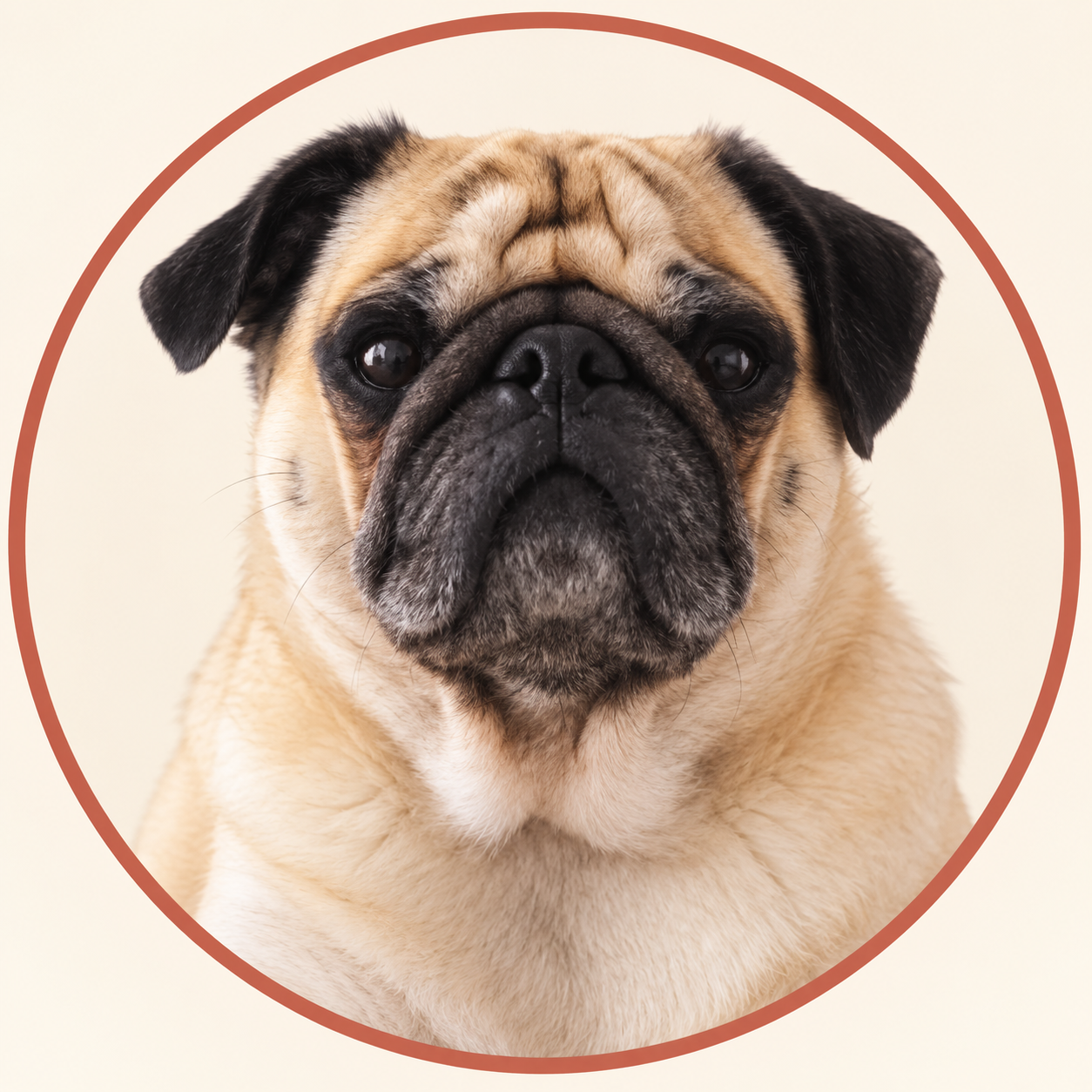
They are funny, affectionate, stubborn little shadows. They are also a brachycephalic breed, meaning generations of selection for a very short muzzle and rounded head have produced physical traits that can be tied to real health problems.
A 2026 UK study asked a useful question: if you cross a Pug with a less flat-faced breed, can you reduce some of those conformation-related health problems without losing the temperament and owner-dog bond people love?
The answer from this study was encouraging—but it needs some fine print.
What the researchers studied
Researchers compared 150 privately owned dogs in the UK:
- 51 Pugs
- 51 Jugs, which are Pug × Jack Russell Terrier crosses
- 48 Puggles, which are Pug × Beagle crosses
The team collected owner-reported information and also performed clinical and physical assessments. They looked at respiratory function, eye and skin problems, musculoskeletal issues, body shape, behaviour, trainability, and the dog-owner relationship.
Most of the Jugs and Puggles in the study were first-generation crosses.
What they found
As groups, the Jugs and Puggles had less extreme facial conformation than the Pugs. They also showed a lower burden of several health problems associated with extreme brachycephalic body shape.
The differences covered areas that matter a lot to Pug owners, including respiratory, eye, skin, and musculoskeletal problems.
The breathing results were especially striking. In the study's respiratory grading, none of the 51 Pugs received the lowest, clinically unaffected grade, while nearly all of the crossbred dogs did.
That does not mean every Pug has severe breathing disease. It does mean this particular group of Pugs showed substantially more respiratory impairment than the two crossbred groups.
The study also found that the crosses generally retained the behavioural traits and strong owner-dog relationships that make Pugs so appealing in the first place. Broad measures such as excitability, aggression, fear/anxiety, and separation anxiety did not differ significantly among the three groups, while the crosses scored better on trainability.
So the basic takeaway is not simply "crossbreed equals healthy." It is more specific:
Moderating the very flat-faced Pug body shape through these two crosses was associated with fewer conformation-related health problems in this study, without obviously sacrificing the close human-dog relationship.
What this study does NOT prove
This is where the internet usually drives the bus into a ditch.
The study does not prove that every Puggle or Jug will be healthier than every Pug.
It does not prove that any random crossbreed is automatically healthy.
It does not tell you the future medical history of the dog sleeping on your couch right now.
And it does not mean responsible health screening suddenly becomes optional because a puppy has two different breeds in its family tree.
The authors were clear about important limitations.
First, the study involved Pugs, Jugs, and Puggles in the UK. Results should be generalized cautiously to dogs in other countries, other crosses, and other brachycephalic breeds.
Second, some health information came from owners rather than medical records alone.
Third, the respiratory grading system used in the study is validated for purebred brachycephalic breeds including Pugs, but has not been validated specifically for crossbred dogs.
Finally, because many of the crosses were first generation, later generations and backcrosses could show more variation.
Those caveats matter. They do not erase the findings; they define what the findings actually mean.
What does this mean if you already own a Pug?
It does not mean you should look at your Pug and feel guilty.
You own the dog in front of you, not a population-level statistic.
The practical job is the same one good Pug owners have always had: pay attention to breathing, heat tolerance, eyes, skin folds, mobility, body condition, and changes in normal behaviour—and involve your veterinarian when something does not look right.
A Pug who struggles to breathe, overheats easily, develops recurring eye irritation, or has other concerning symptoms deserves veterinary assessment. Online breed statistics cannot diagnose an individual dog.
The study is more useful as information about breed welfare and future dog-selection decisions than as a verdict on any Pug already living a loved, well-managed life.
What if you are choosing a future dog?
This research adds evidence to a simple idea: physical shape matters.
A dog with a somewhat longer muzzle, more open nostrils, less prominent eyes, and less extreme overall conformation may avoid some of the problems associated with the most exaggerated flat-faced features.
That is worth considering whether you are looking at a Pug, a Pug cross, or another brachycephalic dog.
But a breed label alone is not a health certificate.
Ask about health screening. Look carefully at the parents when possible. Pay attention to breathing at rest and after normal activity. Be skeptical of anyone promising a "perfectly healthy" dog based only on a trendy crossbreed name.
And for individual health questions, use a veterinarian—not TikTok, not a breeder's marketing page, and not us.
The bigger Pug question
People love Pugs for reasons that have very little to do with muzzle length.
They love the shadow that follows them from room to room. The comic timing. The snorts. The dramatic sigh when dinner is three minutes late. The absurd conviction that a 16-pound dog requires 70 percent of the bed.
This study matters because it suggests some of the things people adore about Pug-type dogs may not require the most extreme version of the physical traits that create health risk.
That is a genuinely interesting result.
It is not the final word. It is not a guarantee. But it is useful evidence—and for a breed whose personality has never been the problem, that is worth paying attention to.
Sources
Youens E, O'Neill DG, Tivers M, Belshaw Z, Neufuss J & Packer RMA. "A solution right under our nose? Crossbreeding extreme brachycephalic dogs results in better health outcomes while preserving behavioural profiles and dog-owner relationship quality." Animal Welfare, 2026. https://www.cambridge.org/core/journals/animal-welfare/article/solution-right-under-our-nose-crossbreeding-extreme-brachycephalic-dogs-results-in-better-health-outcomes-while-preserving-behavioural-profiles-and-dogowner-relationship-quality/FB102B0677C902601F0E1501C3886A5F
British Small Animal Veterinary Association. "How do the health, behaviours and dog-owner relationships of purebred Pugs and Pug-crosses compare?" September 14, 2026. https://bsava.com/article/how-do-the-health-behaviours-and-dog-owner-relationships-of-purebred-pugs-and-pug-crosses-compare/
This article is educational and is not a substitute for veterinary advice about an individual dog.